
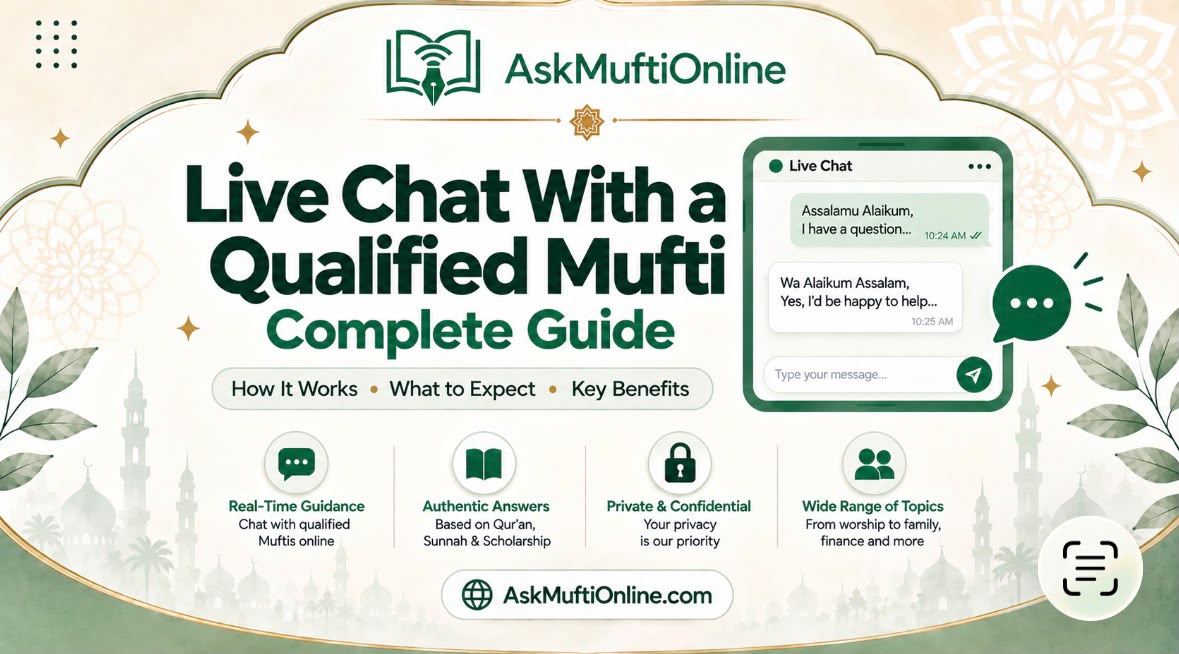
Article
Live Chat With a Qualified Mufti: Complete Guide
How to Use It, What to Expect, and Key Benefits
Sometimes you need instant clarification on an Islamic question. You're preparing for prayer, planning your business finances, navigating a family matter, or simply want to chat with a scholar in real-time rather than wait. That's where live chat with a Mufti comes in.
Unlike traditional Q&A platforms where you submit a question and wait hours or days, live chat connects you directly with qualified Islamic scholars for back-and-forth conversation. Messages appear instantly. You can ask follow-up questions immediately. Misunderstandings get cleared up on the spot. And it's completely accessible.
This comprehensive guide covers how live chat works today, what to expect, the key benefits, best practices, and important boundaries.

Figure 1: AskMuftiOnline Live Chat feature - Real-time, Private, Qualified Muftis
How AskMuftiOnline Live Chat Works Today
Here's the actual workflow:
Sign In & Choose Topic
You sign into your AskMuftiOnline account and open Live Chat. Choose your preferred language (English, Arabic, Urdu, etc.) and the topic category (Ibadah, Marriage, Business, etc.). This helps route you to the right scholar.
Send Your Opening Question
Write a clear opening question: "Is it permissible to work in finance if my company handles interest-based loans?" Your question goes into the waiting queue and is visible to available scholars.
Scholar Accepts the Chat
An authorized scholar reviews your question and accepts the chat when they're available. Scholar availability changes throughout the day. Typical wait: 5-30 minutes when scholars are online. If no scholar is ready, you can leave the conversation in queue or use the asynchronous (written) question form instead.
Real-Time Conversation
Once the scholar accepts, messages update in real time. You'll see typing indicators. They see when you're typing. The conversation flows naturally—like texting with someone who knows Islamic jurisprudence. Typical chat duration: 10-25 minutes.
End Chat & Review Later
When you have clarity, you or the scholar can end the conversation. Your chat history stays in your account forever. You can review it anytime, save it, or reference the guidance later. Authorized administrators may review conversations for quality and safeguarding purposes only.

Figure 2: Three simple steps to start chatting with a qualified Mufti
What to Expect During Live Chat
⏱️ Typical Timing
Wait time: 5-30 minutes for scholar to accept (when scholars are online)
Chat duration: 10-25 minutes for most conversations
Availability: Scholars typically online morning, evening, and weekends
Off-hours: If no scholar is available, use written questions instead
⚡ Real-Time Experience
Messages appear instantly. You'll see when the scholar is typing. They see your typing indicators. Conversation flows like a text conversation, not email exchanges.
This real-time element is what makes live chat different—it feels personal and immediate, not formal.
🔒 Privacy & Confidentiality
Your chat is private between you and the assigned scholar. Other users cannot see it. Your identity stays confidential. Only authorized administrators review chats for safeguarding (no sharing personal details).
You control whether others ever see your chat.
💾 Permanent Record
Chat messages stay in your account forever. You can search your chat history, reference guidance you received, or review a conversation years later.
This is like having a personal note from the scholar—saved and searchable.
📊 Scholar Qualifications
All live chat scholars are verified Islamic experts. They have formal Islamic training, teaching experience, and community references. Each scholar's credentials are verifiable.
This is not a bot or algorithm—you're talking to a real qualified person.
🎯 Follow-Up Clarity
If the scholar's answer raises a new question, you can ask immediately. That's the whole point of live chat—back-and-forth dialogue until you understand.
Unlike written Q&A, you don't have to wait for the next response cycle.

Figure 3: Chat covers Worship, Family & Marriage, Business & Finance, Halal & Haram, Urgent & Personal, and Modern-Day Issues
5 Key Benefits of Live Chat With a Mufti
Instant Answers, No Waiting
Live chat delivers answers in real-time—not hours or days. If a scholar is available, your question gets a response within minutes. For time-sensitive situations (prayer timing, travel decisions, urgent family matters), instant feedback is invaluable.
Clarification & Follow-Ups On The Spot
You don't have to wait for a new response cycle to ask a follow-up. If the scholar's answer confuses you or raises a new question, ask immediately. This back-and-forth dynamic ensures you fully understand before leaving the chat.
Full Context = Better Guidance
Written questions sometimes lack nuance. A scholar reads your submission and answers without seeing the full picture. In live chat, you can naturally add context as conversation unfolds. The scholar understands your situation more completely, and guidance becomes more tailored and accurate.
Personal Connection & Pastoral Care
Live chat is more personal than automated Q&A. You're talking to a real scholar who responds to your tone, concerns, and questions. For sensitive topics (marriage problems, ethical struggles, personal conflicts), this human connection matters. Empathy and patience make all the difference.
Accessible & Affordable
Live chat with qualified scholars should be accessible to everyone. AskMuftiOnline offers live chat at affordable rates because we believe authentic Islamic guidance is a right, not a luxury. Premium memberships offer perks (priority queue), but core scholar access remains accessible to all.

Figure 4: Choose between Live Chat (real-time) or Ask a Question (written answer)
When Is Live Chat Best? Live Chat vs. Written Questions
⚡ Best For Live Chat
Quick clarifications – 5-15 minute conversations
Time-sensitive decisions – Prayer timing, travel, urgent family matters
Follow-up questions – On previous answers you already received
Checking understanding – "Can you explain that differently?"
Multiple questions building on each other – Each answer leads to next question
When context is complex – Easier to explain verbally than write everything
Sensitive topics needing pastoral care – Marriage, family, personal struggles
📝 Better With Written Questions
Complex Islamic topics – Jurisprudence, detailed Fiqh
Situations needing research – Scholar must check multiple sources
You want detailed written answer – With sources and references
Lots of context/background – Easier to write than explain live
You need time to think – Better to reflect than chat spontaneously
No scholar available now – Written questions don't require immediate availability
You want formal documentation – A written record with sources

Figure 5: Every answer from qualified Muftis grounded in authentic sources—2,199+ questions answered with proven scholar expertise
Real-World Use Cases for Live Chat
✓ Perfect Scenarios
- Preparing for prayer—need guidance now
- Traveling tomorrow—prayer time questions
- Wedding planning—quick rulings on halal/haram
- Fasting question—need clarification today
- Business decision—asking about Riba/interest
- Following up on previous written answer
- Confused about a concept—need explanation
- Sensitive personal matter—need pastoral guidance
⊙ When to Use Written Questions
- Studying Islamic jurisprudence deeply
- Need sources cited and referenced
- Complex situation requiring research
- Scholar needs time to look things up
- Want formal documentation for future
- No scholar currently available
- Prefer written over conversational
- Question touches multiple Islamic schools
How to Use Live Chat Effectively: Best Practices
Preparation: Before You Chat (30 seconds)
1. Clarify your main question: What do you really want to know? Write it down as one sentence. This focuses the conversation and respects the scholar's time.
2. Have key facts ready: If your situation has important details (age, location, school of thought, health status), have them in mind. You may not need to share everything, but be ready if asked.
3. Choose language & topic: Select your preferred language and topic category. This helps route you to the right scholar.
During Chat: Best Practices
- Be clear and specific: "Is it permissible to work as a banker?" is clearer than "Is finance halal?"
- Share relevant context: Your age, location, circumstances can change the answer
- Ask follow-up questions: That's literally the point of live chat. "Can you explain that differently?" is perfectly okay
- Ask for examples: "Can you give an example of when this would apply?"
- Be respectful: Remember you're speaking to a scholar who volunteers their time
- Take notes: Screenshot or save important guidance
- Ask about assumptions: "Does this change if I'm in a different school of Islamic law?" or "If my situation was different, would the answer change?"
After Chat: Documentation
Your chat stays in your account. Review it later. Save or print if needed. You can search your chat history for topics you've discussed. This is like having a personal reference library of guidance you've received.
Important Boundaries & What NOT to Do
✓ DO:
- Ask Islamic guidance questions
- Seek clarification on Quranic/Hadith concepts
- Ask about halal/haram in your work/business
- Discuss family matters from Islamic perspective
- Ask about prayer, fasting, Hajj rulings
- Request scholar to explain their reasoning
- Share context if it affects the answer
⊘ DON'T:
- Share passwords or sensitive credentials
- Share intimate images or inappropriate content
- Treat chat as mental health therapy
- Ask for medical diagnosis or legal advice
- Report safety concerns (contact authorities instead)
- Expect instant responses during off-hours
- Be disrespectful to the scholar
Critical Boundaries: This Is NOT For:
- Medical emergencies – Contact a doctor or hospital
- Mental health crises – See a therapist or counselor
- Legal emergencies – Consult a qualified lawyer
- Suicide or self-harm – Call emergency services immediately
- Safeguarding concerns – Report to authorities and child protection services
- Abuse situations – Contact local support organizations
For these, live chat with a scholar is not appropriate. These require professional help from doctors, lawyers, counselors, and emergency services.

Figure 6: FAQs section covering common questions about how to start, privacy, and availability
Frequently Asked Questions
Q: Is live chat really accessible? Any hidden costs?
A: Yes, completely accessible. No card required for basic access, no hidden costs, no ads. Premium membership gets priority queue access, but core live chat remains accessible for all users.
Q: How long do I wait for a scholar?
A: Typical wait is 5-30 minutes when scholars are online. During peak hours (evenings/weekends), wait times may be slightly longer. Off-hours may have longer waits. If no scholar is available, you can close chat and try later, or submit a written question.
Q: Are the scholars really qualified?
A: Yes. All live chat scholars are verified Islamic experts with formal training in Islamic jurisprudence, teaching experience, and community references. Credentials are verifiable on the platform.
Q: Can I ask sensitive or personal questions?
A: Absolutely. Scholars are trained in pastoral sensitivity. They understand that many Islamic questions are deeply personal—marriage, family, ethical dilemmas. Your chat is private and confidential. Only you and the assigned scholar see it.
Q: What if I don't understand the scholar's answer?
A: Ask immediately! That's the whole point of live chat. Say "Can you explain that differently?" or "Can you give an example?" The scholar will clarify until you understand.
Q: Can I save or print the chat?
A: Yes. Chat history stays in your account forever. You can review it anytime, search for topics, screenshot it, or print it. It's like a personal record of guidance you received.
Q: What if the scholar and I disagree?
A: Islamic jurisprudence has multiple valid opinions. If you disagree respectfully, ask why the scholar gave that guidance. Ask what Islamic sources support it. You can also submit the same question in written form to get perspectives from a different scholar.
Q: Is live chat for emergencies?
A: No. Live chat is for Islamic guidance only—not medical emergencies, mental health crises, legal emergencies, or safeguarding issues. For those, contact emergency services, a doctor, therapist, or lawyer immediately.
Q: Can I use this for medical or legal advice?
A: Scholars can discuss Islamic rulings on health/legal matters (what's halal/haram). But for medical diagnosis, treatment, or legal advice, consult a licensed doctor or lawyer. Religious guidance and professional expertise are complementary, not substitutes.
Q: What if no scholar is available?
A: Wait in queue, try again later, or submit a written question. Written questions don't require immediate scholar availability—they go to the scholar's desk and are answered within 24 hours (or 1-3 days for complex topics).
Q: Can I start a new chat after one ends?
A: Yes. You can open as many chats as you need. Start fresh chats anytime. Or, if you want deeper research on the same topic, submit a written question. Many users combine both approaches.
Ready to Chat Live With a Mufti?
Get instant answers to your Islamic questions from qualified scholars. Real-time guidance, no waiting.
Start Live Chat Now →Scholars available daily. Typical wait: 5-30 minutes. No card required.